
Cache County Criminal Docket Searches
The main public search layer for Cache County criminal court dockets is the statewide system, Utah Courts XChange. Choose District Court for felonies and for Class A misdemeanors filed in First District Court. Choose Justice Court for most Class B and C misdemeanors, infractions, city ordinance cases, and much of the traffic docket. One local quirk matters here. Cache County has no county justice court. So the court name printed on a citation, notice, or charging paper is a strong clue about where the case lives.
A case number narrows results best. Utah's public help publishes no stable Cache-specific numbering pattern. Copy every character exactly from the court notice, citation, or an earlier XChange result. Searching by name works. It takes a surname or company name, first-name letters, case type, court scope, citation number, and date filters. The official XChange help page recommends careful wildcard use. It also warns that results stop at 500.
- Choose District Court, Justice Court, or both based on the source paper.
- Enter the exact case number when known; otherwise use name and court filters.
- Narrow the Cache County criminal docket search by location, type, citation, or date.
- Open the case number and read the full chronology, not one status line.
- Compare a future setting with the official calendar and confirm uncertain details with the clerk.
Online access is not the only route. The Cache County/Logan District Court clerk and records staff can explain the correct public process. Stop by 135 N 100 W, Logan, Utah 84321. Or call 435-750-1300. A free public terminal at the courthouse opens XChange's public case information. When an eligible item is not online, a specific record request is available. Older material may require the court or Utah State Archives.
Cache County Criminal Cases Split Courts
One local fact prevents many wrong searches: Cache County never had a county justice court. First District Court in Logan is the general-jurisdiction court. It holds the felony and Class A misdemeanor dockets. Municipal justice courts keep many lower-level criminal and ordinance dockets within their limited jurisdiction. Assume the county handles everything, and the right record can stay hidden.
| Matter | Likely docket | Search choice |
|---|---|---|
| Felony | First District Court, Logan | District Court in XChange |
| Class A misdemeanor | First District Court, Logan | District Court in XChange |
| Class B or C misdemeanor | Applicable justice court | Justice Court in XChange |
| City ordinance or infraction | Applicable municipal court or successor court | Verify current location |
Court structure can change. A 2025 Utah joint resolution approved dissolving the North Logan and Hyde Park justice courts and directed their workload to First District Court. Earlier official materials described Smithfield's transition. Even when the docket is kept in Logan, a city name in a caption can still identify the prosecuting municipality.
Criminal Dockets: What They Show
A Cache County criminal docket pairs basic case data with a dated event history. The header may list the court and location. It may also show the caption, case number, case type, filing date, judge, and status. Later entries can show the charge and its level. They can also list agency details, plea, hearing dates, orders, disposition, sentence, due dates, and financial activity. These fields describe what court staff entered in the record. They do not replace the signed order or the certified case file.
| Case number | Use the exact Utah number shown by the court; do not infer a format. |
|---|---|
| Charge | Offense, level or class, citation data, and prosecuting agency where public. |
| Setting | Date, time, judge, courtroom, location, and hearing type when entered. |
| Plea | The response entered to a charge, with its own date and nature. |
| Disposition | The recorded result for the case or a specific charge. |
| Documents | Available public images are separate from the free case history. |
Utah classifies records with a coding system, and the official XChange case-type list lays out the categories. Its code reference appears on the official page.
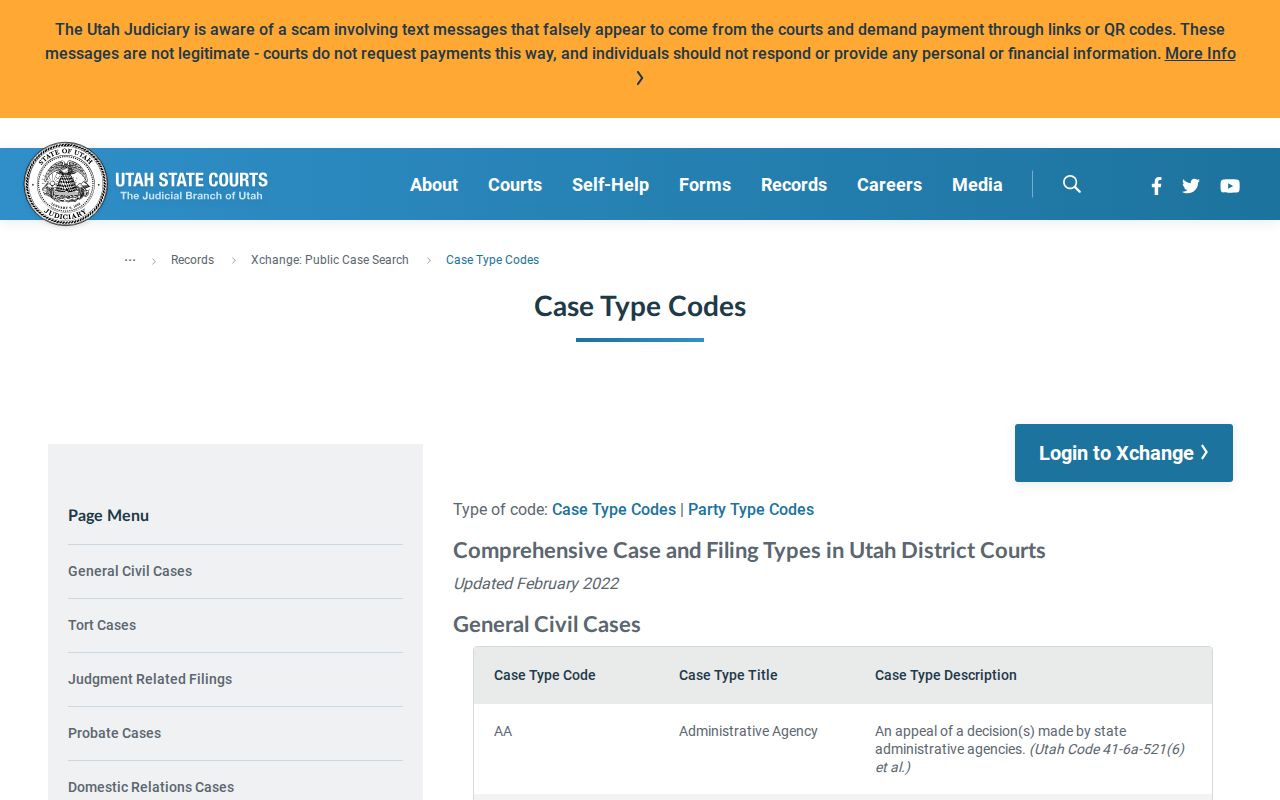
A code helps narrow the docket search. Still, it is only a category. It is not a plea, a judgment, or any finding about the case.
Read Three Cache County Criminal Fields
Charge, plea, and disposition answer three different questions. A charge states what the prosecution alleged. A plea records the defendant's formal response. A disposition records what happened to the charge or case. Treating the first visible charge as a conviction is a serious reading error. A dismissed count, deferred process, plea in abeyance, conviction, and pending case each leave a different trail in the docket.
- Charge
- The offense alleged in the filed criminal matter, often paired with a level or class.
- Plea
- The formal response, such as guilty, not guilty, or no contest, as the record states.
- Disposition
- The result entered for a charge or case, with a date that may differ from the hearing date.
- Setting
- A scheduled court event. It is not itself an outcome.
Financial entries also deserve care. A Cache County criminal case history may list fines, fees, paid amounts, or a balance. Those figures do not explain the whole judgment. Read the order and disposition entries together. Ask the court when the public history is unclear.
Note: A short XChange code identifies a field or role; it does not prove a final judgment or conviction.
Criminal Case Stages on the Docket
A Cache County criminal docket grows as the case moves. The first public entries may show a citation, information, charge, initial appearance, or warrant-related event. Arraignment addresses the charge and the plea process. After that, a preliminary-hearing decision, pretrial conference, or motion entry marks an interim step, with plea, trial, disposition, and sentencing entries arriving when those events occur.
Docket flow: Filing › Arraignment › Pretrial › Plea or Trial › Disposition › Sentencing
Cases rarely follow one clean line. A continuance moves a setting to a new date. An order to show cause asks a party to explain a compliance issue. A review can happen after sentencing. An appeal may open a separate appellate number and record in the Utah Court of Appeals or Utah Supreme Court. Read the dates in order and find the latest controlling entry.
Cache County Criminal Settings and Calendars
Two tools answer different questions. The public case history gives you the chronology. The Utah Courts calendar focuses on scheduled proceedings. You can search it by date, location, case number, party, judge, or attorney. A Cache County criminal docket can still show an old continuance or hearing entry. That can persist even after a new date is set. Always confirm the current setting. For a District Court matter, choose the Logan location. Compare the calendar result with the newest case-history entry. The calendar may list time, courtroom, judge, setting type, and whether the setting is in person or remote. If a Webex link is absent, contact the judge's team or the court. A remote link never authorizes recording, photographing, or transmitting proceedings.
When dates differ: Check the newest calendar result, read the last XChange setting or order, then call 435-750-1300 before relying on an older date.
Cache County Criminal Docket Courts
Every felony and Class A misdemeanor filing in Cache County goes to First District Court in Logan. The district spans three counties, adding Box Elder and Rich. Justice courts sit below it with limited authority. They handle most Class B and C misdemeanors, infractions, traffic matters, and local ordinances. Records from a municipal justice court stay with the court that heard the case, though later transfers or dissolutions can move them. The district's workload is context, not a case result. The official 2024 Utah Courts Annual Report counted 10,570 new First District cases in fiscal 2023 across all three counties. That total ran 21.4 percent above the ten-year average. Criminal filings were 28.5 percent above the comparable average. Big totals say nothing about one case. They cannot tell whether a Cache County criminal case is set, delayed, sealed, or disposed.
Numbers help you see why precise court and case filters matter. They are not a reason to add district and municipal totals together, and a clearance rate is never a promise about processing time.
Missing Cache County Criminal Docket Results
Missing results usually have ordinary causes. The search may use the wrong jurisdiction, court, date range, spelling, or citation digits. Logan District Court's electronic CORIS coverage starts August 18, 1997. Material older than that may be incomplete online. The case itself could also be sealed, expunged, juvenile, private, newly entered, or held under another authorized access process.
- Switch between District Court and Justice Court when the court level is uncertain.
- Retry the exact case number, then approved name and wildcard variations.
- Remove narrow date filters and check the current public calendar.
- Call the applicable clerk without asking staff to disclose protected information.
- Use the Utah Courts record-request process for a public item that is not online.
Switching portals changes nothing. Utah court rules still control a sealed or private record. If access is legally available through a party relationship, an authorization, or a court order, follow the court's prescribed process and provide that basis.
Access Rules for Criminal Dockets
Utah starts from openness. Court records are public unless a rule classifies them as private, protected, sealed, or otherwise restricted, and public access can include case indexes, calendars, open-hearing records, judgments, and orders. A name or number is not a key. It does not open juvenile delinquency, child-welfare, sealed, expunged, or protected records. Public XChange also is not the complete evidence file, transcript, audio, or certified record.
The Utah redaction rule places responsibility for protected identifiers on parties and filers. The official page shows the full rule text.
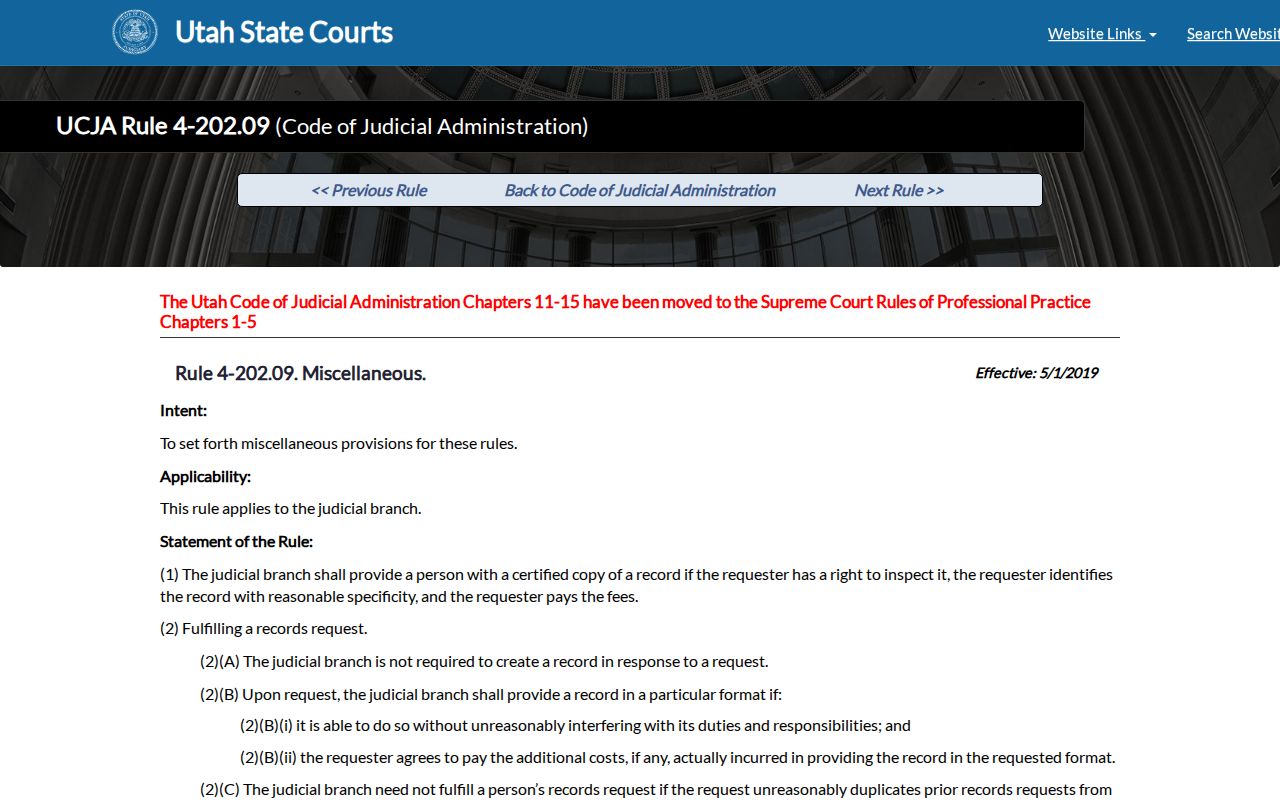
This is why a public Cache County criminal docket can omit identifiers. Openness never licenses republishing protected or sensitive data.
Key Utah rules:
UCJA 4-202.02 classifies public and private court records.
UCJA 4-202.03 governs access to public and nonpublic records.
UCJA 4-202.04 provides a process to seek access to a nonpublic record.
Document images cost $1 each through XChange. The price holds no matter the page count. A browser summary or purchased image is not certified automatically, so ask the court for authentication when a certified copy is required.
Cache County Criminal Records Need Verification
The strongest reading stacks three sources. Use the XChange history for events. Use the calendar for the present setting. Use the clerk for an official or unclear point. The portal updates as staff enter data into CORIS. Coverage and public classification still shape what appears. An older paper file, a newly accepted entry, or a restricted document may call for another channel.
Keep the request precise. Bring the case number, court level, court location, approximate filing date, and the exact document or event needed. Ask by its correct name. Say public inspection, plain copy, document image, or certified copy. That habit keeps a free case history distinct from the full filed-document record. For a broader name or number workflow, the Cache County docket search details XChange fields and scope choices. For a current appearance, the Cache County court schedule separates the live setting from old docket events.