
How the Cache County Court Calendar Works
The Utah Courts public calendar is the official home of the Cache County court schedule. It is not the same tool as XChange. The calendar organizes settings by day and place. XChange gives you the full case history in order. Per the current public notice, full court calendars have replaced the older PDF versions. They refresh on weekdays at about 5:30 a.m.
A search there can run on case number, party name, judge, attorney name or bar number, date, location, and court type. Logan District Court serves as the central Cache location for district cases. Municipal justice courts may show up for lower-level matters. Their status varies, though, since local courts sometimes dissolve or transfer their work.
| Calendar field | Input | Use |
|---|---|---|
| Case Number | Exact Utah case number | Narrowest case search |
| Party Name | Name as filed | Find a caption when number is unknown |
| Judge Name | Selected judge | Review one judicial calendar |
| Attorney | First and last name or bar number | Find settings tied to counsel |
| Date and Location | Chosen day and court | View a local calendar |
The direct calendar interface also offers full-court results, print controls, sorting, and a View Case Details link. Full results can include party, attorney, and charge data. Use them to locate the public proceeding only, and skip republishing sensitive identifiers.
Cache Calendar Search Controls
The Utah calendar interface holds the search controls behind a Cache County court schedule lookup. That official page presents the calendar entry point for docket searching without live party names as sample content.
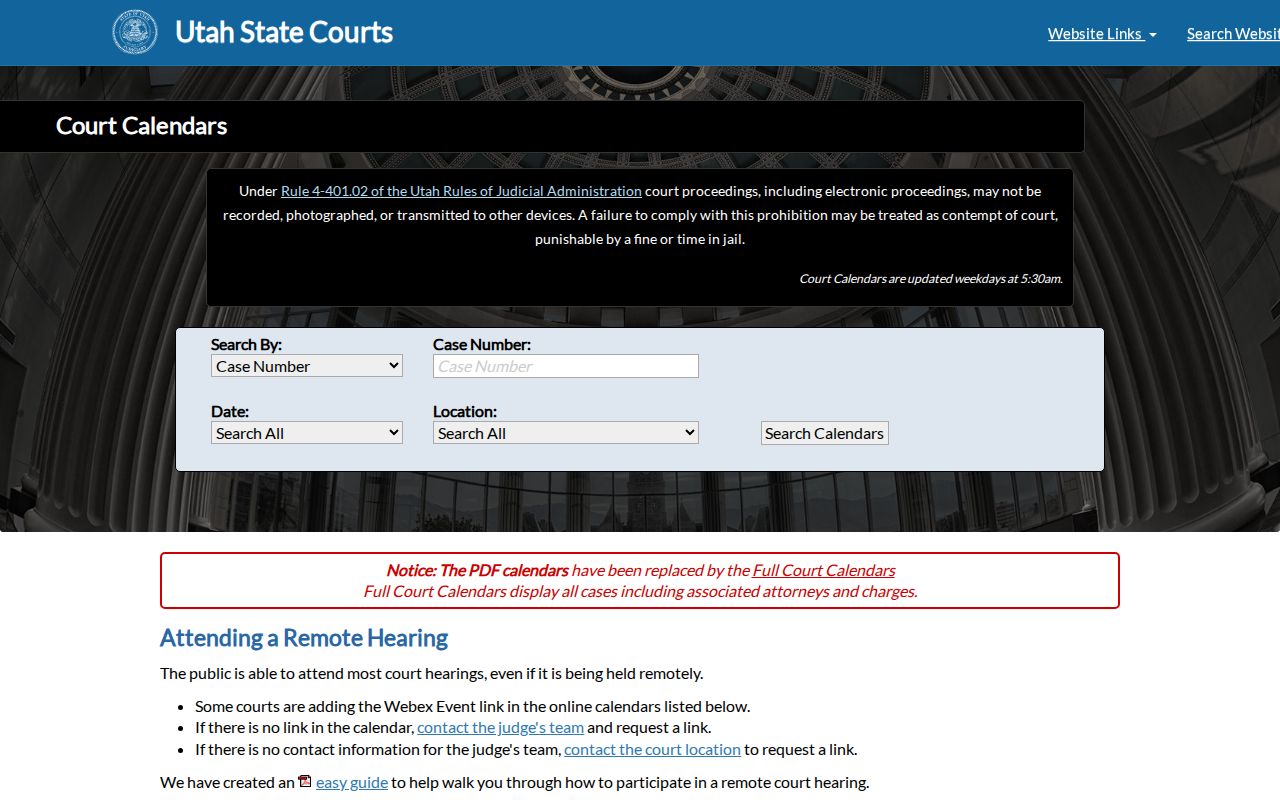
Why so many controls? A visitor may arrive with a case number, a judge, a date, or just a court location. Each path needs its own field. Not every box is marked as required. So lead with one strong identifier and add narrow filters instead of guessing which fields are mandatory. The current Utah Courts calendar route is the second official page in view here.
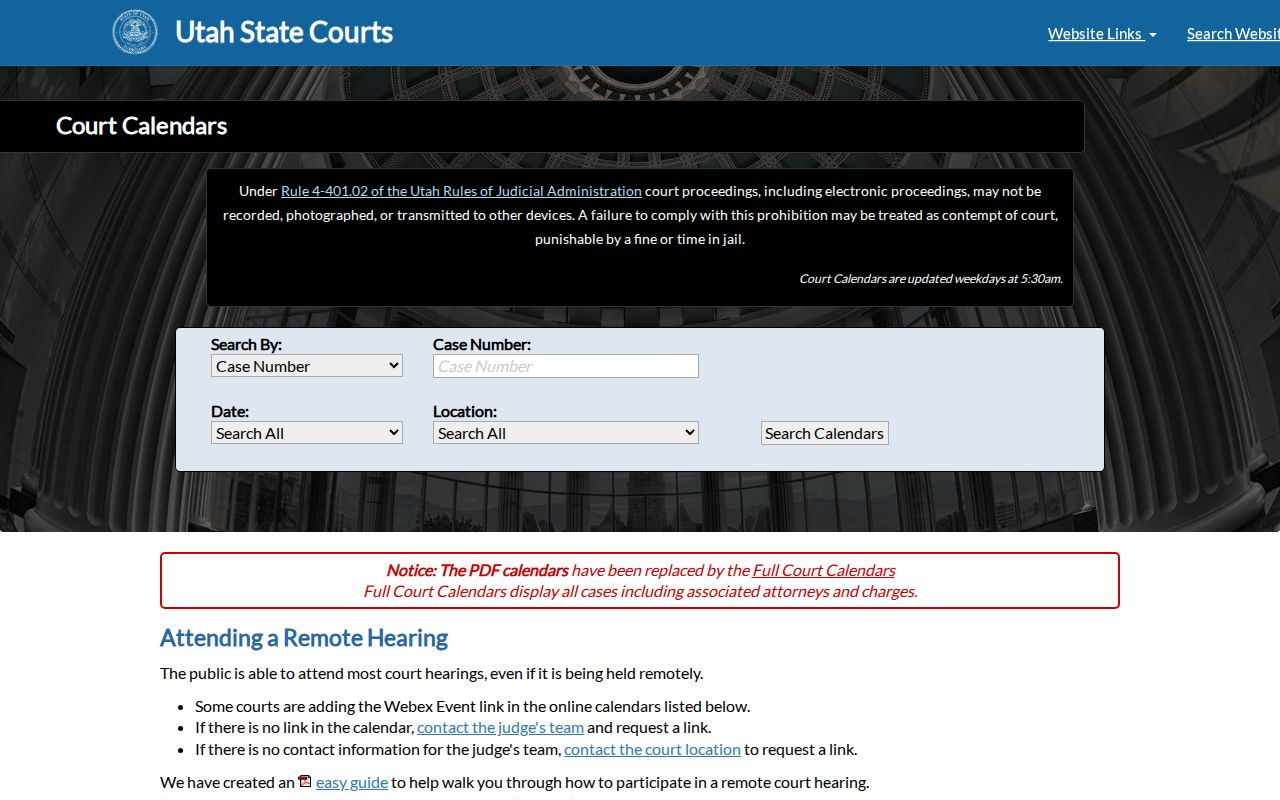
Both routes lead to the same public setting system. Neither one replaces the filed notice or a clerk's confirmation when timing is in doubt.
Cache County Court Date Lookups
Begin with the exact case number if you have it. The generic calendar page does not publish a Cache-specific number pattern, so copy the number from a notice, citation, XChange record, or clerk letter. No number handy? Combine party, date, court type, and location fields. That keeps the results list from ballooning.
- Open the Utah Courts calendar and choose the relevant court type.
- Enter the case number, or search by party, judge, or attorney.
- Select the date and Logan or applicable municipal court location.
- Open the result and note the current time, court, judge, room, and setting type.
- Use View Case Details to compare the setting with the newest XChange history.
- Call the applicable clerk if the date, mode, or location conflicts with a notice.
For Cache District and Juvenile Court questions, call 435-750-1300. You can also visit the clerk counter at 135 N 100 W, Logan, Utah 84321. Logan City Justice Court lists 435-716-9300 on the official county small-claims source. Other municipal matters belong with the current court directory and the city court's verified line. In person, courthouse public terminals, posted calendars, and the clerk counter all work. Cache County offers no separate daily-docket PDF archive.
Logan Anchors Cache Court Dates
Logan is the Cache County seat and the physical home of First District Court. That makes Logan District Court the calendar location to watch for felony, Class A misdemeanor, general civil, domestic, probate, juvenile, and qualifying small-claims matters. Justice court cases sit at the applicable municipal location. A successor court may take over after a transfer. The official Logan calendar sample shows what the court publishes for that location. It does not reproduce party names or case identifiers in the text here.
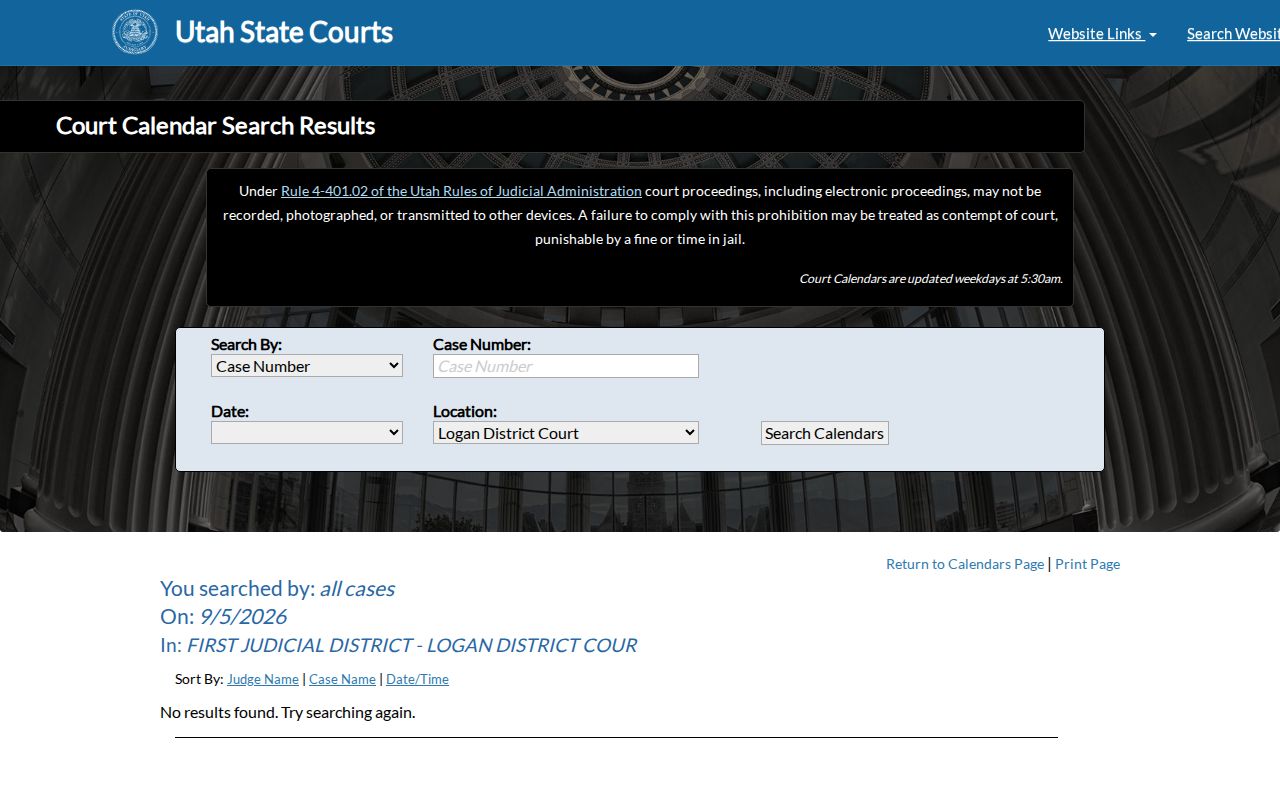
The sample shows the shape of a local result: date and time, Logan location, judge, courtroom when listed, setting label, and a case-detail path. Live results shift with the day's docket.
Quick check: A Cache County city name in the case caption may identify the prosecuting city, while Logan District Court is the current hearing location.
Court Settings: What Each Field Means
A setting is a scheduled court event, not a result. Date and start time tell you when the matter should be called. The court and location fields point to the building or the remote calendar. The assigned or presiding judge names the judicial officer for that setting. A courtroom field narrows the in-person destination. The hearing label describes the event's purpose.
| Date and time | The scheduled start, subject to later court action. |
|---|---|
| Court and location | District, juvenile, or justice court and the listed Cache location. |
| Judge | The judicial officer shown for that calendar setting. |
| Courtroom | The room when displayed; confirm if blank or changed. |
| Setting type | Initial appearance, arraignment, pretrial, motion, sentencing, review, trial, or another exact label. |
| Attendance mode | In-person, remote, or hybrid indication when supplied. |
A Webex link may appear for a public remote hearing. If it does not, reach the judge's team or the court. Utah's calendar warns that Rule 4-401.02 prohibits recording, photographing, or transmitting a proceeding. Remote access lets you attend. It does not let you capture or redistribute the hearing.
Cache Setting Types in Plain Terms
Labels on the Cache County court schedule mark a procedural step. Read the exact label first. A hearing title can say what the court plans to address. It cannot tell you what order will result. Criminal, civil, and review calendars also mix their terms differently.
- Initial appearance
- An early appearance after a new filing or custody event, not a final disposition.
- Arraignment
- A criminal setting where the charge and plea process are addressed.
- Pretrial conference
- A management or negotiation setting before trial.
- Sentencing
- A post-conviction setting for the court to impose sentence.
- Order to show cause
- A hearing asking a party to explain an alleged compliance issue.
- Status or review
- A check on progress or compliance; confirm the precise purpose in the docket.
Other labels you may see include decision to preliminary hearing, hearing on warrant and arraignment, motion hearing, trial, and court-specific events. Utah publishes no Cache-specific code dictionary. Trust the words in the live calendar, and call the court when a shortened label is unclear.
When a Court Date Moves
A reset, pass, or continuance shifts a hearing to a new day. The docket keeps the old event in its history. So two dates can look equally real at a glance. Check the later entries for a notice of setting, an order, or a calendar line. A line reading "hearing held" only records what already happened. It is not the next court date.
Stack three sources side by side. Use the most recent calendar result, the newest XChange event, and the notice the court mailed out. If they disagree, call the court before you show up. Holidays, weather closures, judicial orders, and local standing orders can all move a setting too. The First District page posts local forms plus administrative and standing-order links.
Note: A reset moves the schedule only. It does not itself dismiss the case or resolve any pending claim or charge.
Cache Court Changes Affect Schedules
Court geography in Cache County has shifted recently. Utah SJR 1 in 2025 dissolved the North Logan and Hyde Park justice courts. It sent their caseloads to First District Court in Cache County. Judicial Council materials from 2024 show the transfer was planned. It was not the product of a missing calendar page. Smithfield went through its own dissolution earlier, and the older records document it.
That history sets a calendar trap. Search only the old city location and you can miss a current Logan hearing. Run the case number across the right court type. Read the court and location field closely. Rely on the current Utah Courts directory. A dissolved municipal name on an old docket event does not mean the next hearing stays there.
The official legislative page shows the resolution itself.
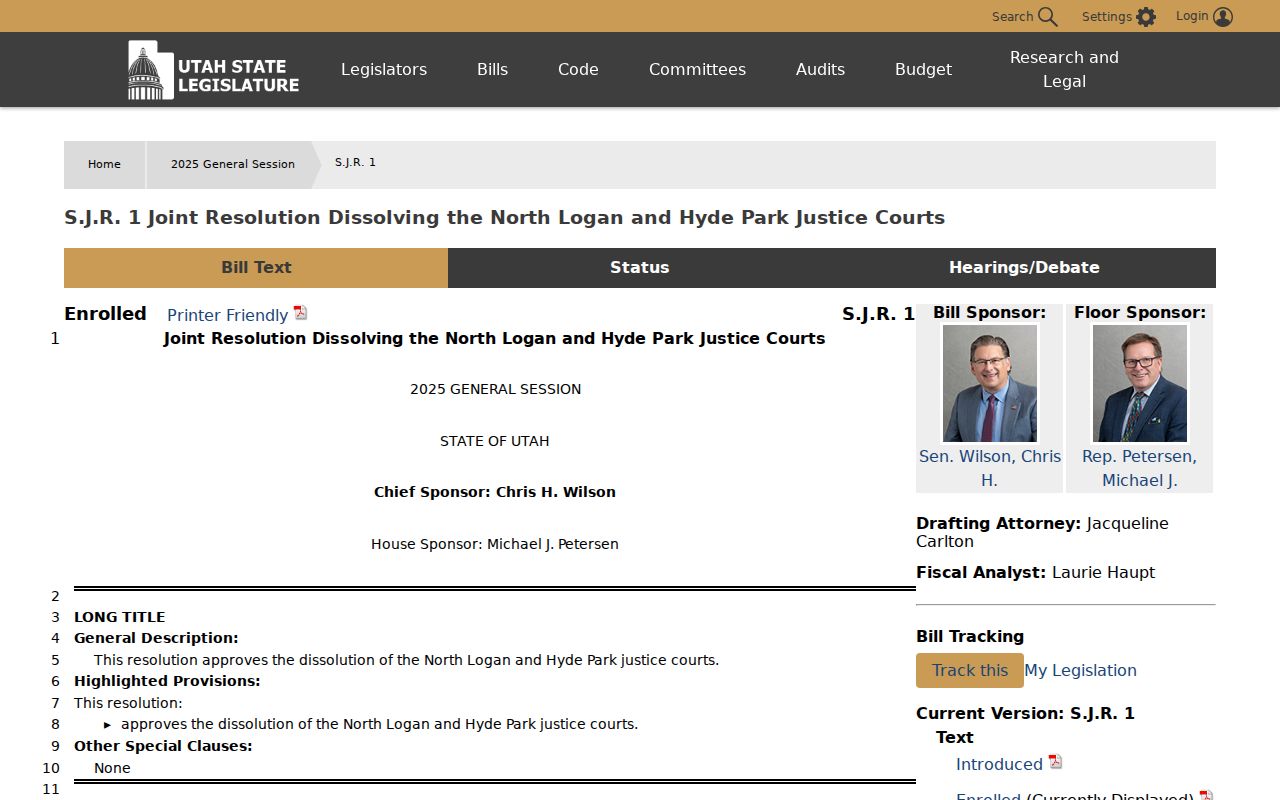
The resolution explains why caseloads moved. For any specific date or place, the live calendar and the clerk still govern.
Cache Calendar and Docket Compared
The calendar, the docket, and the official notice overlap, yet each does its own job. The calendar tells you when and where a public setting sits. The docket lists what events have been entered across the case's life. A signed order or filed notice often holds detail a calendar row cannot fit. When two sources truly clash, the clerk settles it.
| Source | Best use | Limit |
|---|---|---|
| Public calendar | Current date, time, location, judge, setting | Not the complete case history |
| XChange | Chronological public events and case details | Old settings remain as history |
| Court notice or order | Directions issued in the case | May be superseded by later action |
| Clerk confirmation | Resolve an unclear or conflicting setting | Staff cannot give legal advice |
Full calendars list every case and sometimes reveal attorney or charge details. Search by case number whenever you can. A public calendar also cannot unlock sealed, juvenile, private, or expunged records.
Missed Settings and What Comes Next
Move fast after missing a Cache County court setting. Open the case history. Look for a new order, a warrant-related entry, a default, a dismissal, or a reset. Then call the correct court. Never assume a fresh online date erases the failure to appear. The outcome depends on the case type and on what the judge actually entered.
Missed setting: Contact the listed court at once, follow any entered order, and seek legal advice when rights or deadlines may be affected.
For a district matter, call the Cache County/Logan clerk at 435-750-1300. For a justice matter, confirm which court now holds the case. Do not dial a dissolved location. Have your case or citation number in hand. Staff can tell you the current public setting and how to get the order. But they will not advise you on a plea or a motion.
The Cache County docket search helps you pull the full public history after a missed date. When a setting label alone lacks context, the Cache County criminal court dockets can trace criminal proceedings further.
Confirm Every Cache Court Setting
A solid date check ends at the newest source. Search by exact number, and pick the present court and location. Note the setting type. Then compare the XChange chronology. A transfer, continuance, remote link, or conflicting notice deserves a call to the clerk. That brief verification beats a cached result or a stale printed calendar.
Carry the full setting detail with you: case number, date, time, court, location, judge, room, and attendance mode. For remote proceedings, follow only the link the court published. For in-person ones, confirm the courthouse and room. Public does not mean recordable, on either path.
Cache County posts no separate daily-docket PDF. The statewide calendar, the case history, posted courthouse notices, and the clerk form the fallback chain.